How Does a Cone Crusher Work? The Complete Guide to Operation, Parts & Maintenance
Ever wondered how massive rocks are transformed into perfectly sized aggregates for construction? At the heart of this process often lies a cone crusher. Unlike simple hammering or compression, a cone crusher utilizes a sophisticated gyrating motion to break down materials efficiently. Here’s a breakdown of its core working principle. The machine consists of a fixed outer concave (often called the bowl liner) and a gyrating inner mantle mounted on an eccentric shaft. The eccentric shaft causes the mantle to precess in a circular path, but it does not rotate on its own axis. As the mantle gyrates, it periodically moves closer to and away from the concave. When feed material enters the top crushing chamber, it is squeezed and crushed between the moving mantle and the stationary concave. The crushed product then falls downward due to gravity, passing through the narrowing gap until it reaches the desired size and exits at the bottom. This progressive crushing action from larger to smaller sizes is what makes the cone crusher so effective for secondary and tertiary crushing stages.
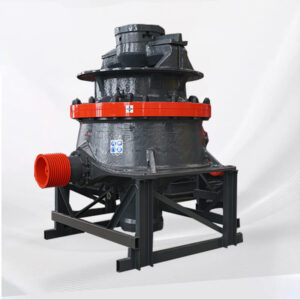
Key Components of a Cone Crusher and Their Roles
A cone crusher is a symphony of precision parts working in unison. Knowing its key components is crucial for understanding its operation and maintenance.
Mantle & Concave (Bow Liner): These are the primary wear parts and the heart of the crushing process. The mantle is the moving cone-shaped part, while the concave is the stationary lining. They are made from high manganese or other wear-resistant steel. Their geometry directly determines the product size and shape.
Eccentric Assembly (Eccentric Bushings, Shaft): This is the “engine” of the gyratory motion. The eccentric bushing, driven by a gear, causes the main shaft and mantle to gyrate. Its precision ensures smooth and consistent crushing action.
Main Shaft: This heavy-duty steel shaft carries the mantle and transmits the gyratory motion from the eccentric assembly. It must withstand immense torsional and bending forces.
Countershaft Assembly (Pinion & Gear): This assembly, often including a bevel gear and pinion, transmits power from the motor to the eccentric bushing, converting rotational motion into the necessary gyratory action.
Hydraulic System: Modern cone crushers rely heavily on hydraulics for key functions: Adjusting the CSS (Closed Side Setting) to control product size, providing overload protection (tramp release) by lifting the mantle to pass uncrushable material, and facilitating cavity clearing for quick maintenance.
Drive System (Motor, V-Belts/Sheaves): Provides the primary power to rotate the countershaft. Proper belt tension is vital for efficient power transmission.
Feed Plate/Distribution Plate: Mounted at the top, it ensures an even distribution of feed material around the entire crushing chamber, preventing uneven wear and optimizing capacity.
Lubrication System: A dedicated pump circulates oil to critical bearings (eccentric, countershaft, main shaft) to reduce friction, dissipate heat, and prevent wear. It is the lifeblood of the crusher.
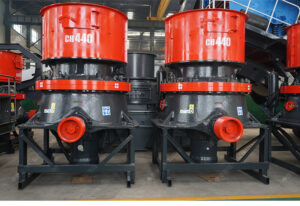
How to Use and Maintain Your Cone Crusher for Longevity
Proper operation and disciplined maintenance aren’t just recommendations; they are the pillars of maximizing uptime and return on investment. Operation: Always start the crusher empty and allow it to stabilize before feeding. Use a regulated feed system (like a feeder) to ensure a steady, choked feed that fills the crushing chamber evenly. This promotes inter-particle crushing, improves product shape, and protects wear parts. Crucially, never exceed the crusher’s designed maximum feed size or hardness. Maintenance: This revolves around a proactive schedule. Daily: Check oil levels, temperature, and pressure in the lubrication system. Listen for unusual noises and inspect for leaks. Weekly/Monthly: Inspect wear parts (mantle/concave) for thickness and check drive belt tension. Regularly: Monitor liner wear and plan for timely replacement—running worn-out liners reduces efficiency and risks damage to other components. The single most important maintenance task is ensuring the lubrication system is flawless. Use the correct oil grade, change filters as scheduled, and watch for contamination. Always follow lock-out/tag-out procedures before any inspection or maintenance.
Additional Insights on Cone Crusher Selection and Optimization
Beyond basic operation, getting the most from your cone crusher involves strategic choices. Firstly, selecting the right crushing chamber profile is paramount. A standard chamber is for secondary crushing, while a fine or extra-fine chamber is tailored for producing sand or tertiary crushing. Matching the chamber to your product goal prevents bottlenecks. Secondly, consider automation systems. Modern crushers can be equipped with ASRi (Automatic Setting Regulation) or similar technology. These systems automatically adjust the CSS in real-time based on crusher load, maintaining optimal throughput and product consistency while protecting the machine. Lastly, don’t underestimate the impact of wear part metallurgy. While standard manganese steel is common, opting for specialized alloys or composite materials for severe applications can dramatically extend liner life, reducing your cost per ton in the long run. Remember, a cone crusher is a system; optimizing feed from upstream equipment and ensuring proper downstream screening are just as critical as the crusher itself.
Final Thoughts: More Than Just a Machine
In the aggregate production line, a cone crusher is a significant capital investment. Treating it as more than just a black box that “crushes rock” can unlock substantial operational benefits. By understanding its intricate working principle, respecting the function of each component, adhering to disciplined operational routines, and committing to preventative maintenance, you transform it from a cost center into a reliable and productive asset. Paying attention to the subtle signs—a slight increase in oil temperature, a change in crushing sound, or a gradual shift in product gradation—allows for predictive intervention before a minor issue escalates into a major downtime event. In essence, mastering your cone crusher is a continuous process of learning and attentive care.