What is a Gyratory Crusher?
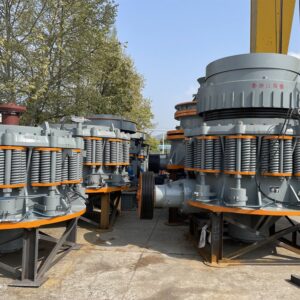
A Gyratory Crusher is a large industrial machine used to crush hard and abrasive ores and rocks in the primary crushing stage. It is characterized by a central vertical spindle (or shaft) that is suspended at the top and gyrates within a stationary, concave crushing chamber.
Think of it as a giant, inverted cone. The main shaft is fitted with a crushing mantle, which gyrates in an eccentric motion against the stationary concave liners. This action crushes the feed material as it enters the top of the crusher, breaking it down into smaller pieces that discharge from the bottom.
How Does a Gyratory Crusher Work? Understanding the Principle
The working principle of a gyratory crusher is elegant in its power and simplicity:
Feed Entry: Large rocks (feed material) are loaded into the top of the crusher from a dump truck or a feed hopper.
Crushing Chamber: The material enters the space between the gyrating mantle (attached to the main shaft) and the stationary concave liners.
Eccentric Motion: The heart of the crusher is the eccentric assembly located at the bottom of the main shaft. This mechanism causes the shaft and mantle to gyrate in a circular path, but without a full rotation. This creates a progressive, compressive crushing action.
Compressive Crushing: As the mantle gyrates, it repeatedly moves towards and away from the concave. When it moves closer, it compresses the rock against the concave, breaking it. When it moves away, the crushed material falls further down the chamber to be crushed again by the next cycle or until it is small enough to pass through the discharge opening at the bottom.
This process ensures continuous operation, as the crusher can handle a steady flow of material without needing to stop, unlike a jaw crusher which has a reciprocating motion.
Key Differences: Gyratory Crusher vs. Cone Crusher
While both are compression crushers, Gyratory and Cone Crushers serve different purposes and have distinct designs.
Key Benefits of Using a Gyratory Crusher
Why should you choose a gyratory crusher for your project? The benefits are substantial for high-tonnage operations:
High Capacity and Productivity: Gyratory crushers are designed for continuous, high-volume crushing, making them ideal for large-scale mining and quarry operations.
High Reduction Ratio: They can take very large feed material and reduce it to a manageable size in a single pass, often eliminating the need for multiple primary crushing stages.
Continuous Crushing Action: The gyrating motion provides a steady, uninterrupted flow of material, leading to smoother operation and higher efficiency compared to the cyclical action of a jaw crusher.
Energy Efficiency: At high capacities, the continuous action of a gyratory crusher can be more energy-efficient per ton of material crushed than a jaw crusher.
Versatility in Liner Design: Different profiles of mantles and concaves can be selected to optimize performance for specific feed materials and product requirements.
What Machines Can a Gyratory Crusher Be Paired With?
A gyratory crusher is the starting point of a crushing circuit. It works in harmony with other equipment to create a complete processing plant:
Primary Feeder: A vibrating grizzly feeder or apron feeder is used to regulate the feed rate into the crusher, ensuring it is not overloaded.
Conveyors: Belt conveyors transport the crushed material from the gyratory crusher’s discharge to the next stage of processing.
Secondary & Tertiary Crushers: The output from a gyratory crusher is typically fed to Cone Crushers for further reduction.
Screens: Vibrating screens are used to separate the crushed material by size. Oversized material is sent back to a crusher (a cone crusher for closed-circuit crushing), while correctly sized material proceeds to the next stage or stockpile.
We Provide High-Quality Compound Cone Crushers for Your Success
Choosing the right crushing equipment is critical to your project’s profitability and longevity. We are your trusted partner for reliable and high-performance crushing solutions.
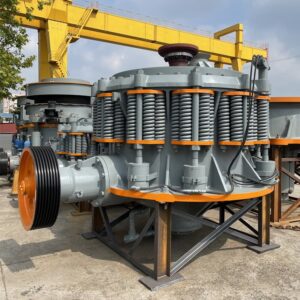
We can provide you with a robust Compound Cone Crusher tailored to your specific needs, whether you are in mining, quarrying, or aggregate production. Our crushers are engineered for maximum productivity, ease of maintenance, and long service life, ensuring you get the best return on your investment.
Contact us today to discuss your requirements. Let our experts help you select the perfect Compound Cone Crusher to optimize your crushing circuit and boost your productivity.