What is a Gravel Production Line?
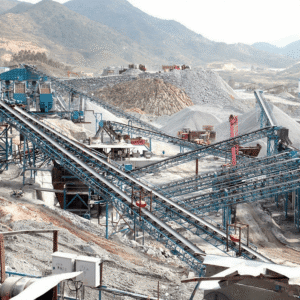
A Gravel Production Line, also known as an aggregate crushing plant or sand and gravel plant, is a coordinated set of industrial machines designed to process raw rock materials into specific sizes of gravel, sand, and stone aggregates. The process involves breaking down large rocks (boulders or cobbles) through a series of crushing and screening stages to produce finished products that meet precise size and shape specifications for various construction applications.
In essence, it transforms naturally occurring or blasted rock into the fundamental building materials that form the foundation of our infrastructure.
Essential Equipment for a Gravel Production Line
A typical and efficient gravel production line consists of several key pieces of equipment, each playing a critical role:
Feeder: The first component, responsible for evenly and consistently transferring the raw materials from the hopper to the primary crusher.
Primary Crusher: This is the workhorse that handles the largest rocks. Common types include Jaw Crushers (for high compression strength rocks) and Gyratory Crushers (for high-capacity operations).
Secondary Crusher: It takes the crushed material from the primary crusher and reduces it further. Impact Crushers are popular for producing a well-shaped, cubical product, while Cone Crushers are excellent for hard and abrasive rocks.
Tertiary Crusher (if needed): For producing very fine aggregates or specific chip sizes, a third crushing stage might be employed, often using Cone Crushers or Vertical Shaft Impact (VSI) Crushers for sand making.
Vibrating Screen: This machine separates the crushed material into different size groups. Oversized material is sent back to the crushers for further processing, while correctly sized material is sent to the final product piles.
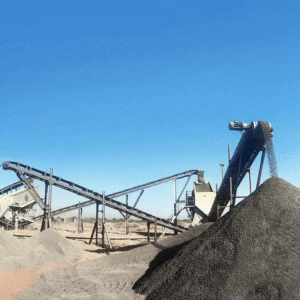
Conveyor Belts: The backbone of the entire system, conveyor belts transport material between all the different stages of the production line.
Accessories: This can include Sand Washers (for cleaning and removing clay/dust), Dust Collection Systems (for environmental protection), and control panels.
What Types of Rock Can a Gravel Production Line Crush?
A well-designed gravel production line is versatile and can process a wide range of hard rocks and minerals, including:
Granite: A very hard and abrasive rock, ideal for high-quality concrete aggregate and road base.
Basalt: Dense and durable, often crushed for use in railroad ballast, asphalt aggregates, and concrete.
Limestone: A softer rock that is easily crushed, commonly used for concrete, cement production, and road base.
River Stone / Cobblestone: Naturally rounded stones that are crushed to create high-quality construction aggregates and landscaping materials.
Quartzite: A very hard and erosion-resistant rock, excellent for high-wear applications.
Andesite & Other Abrasive Rocks: Suitable for specialized crushing configurations.
Main Applications of Gravel Production Lines
The aggregates produced by these lines are fundamental to numerous industries:
Construction & Concrete Production: As a key ingredient in ready-mix concrete and pre-cast concrete products.
Road & Highway Construction: For base layers, sub-bases, and asphalt aggregate.
Railway Ballast: Providing stability and drainage for railway tracks.
Building Foundations and Backfill: As a stable and draining base for structures.
Landscaping and Decorative Purposes: Various sizes of gravel are used for pathways, driveways, and garden features.
Key Features and Advantages of Our Gravel Production Line
Our gravel production lines are engineered for maximum efficiency, reliability, and return on investment.
High Automation & Efficiency: Advanced control systems minimize manual labor and ensure continuous, high-volume output.
Robust & Durable Equipment: Built with high-quality materials to withstand the harsh conditions of aggregate processing, reducing downtime.
Excellent Product Shape Control: The multi-stage crushing process, especially with impact or cone crushers, ensures a cubical and well-graded final product, which is superior for construction.
Flexibility & Customization: The plant layout and equipment can be tailored to your specific raw material and final product requirements.
Environmental Compliance: Equipped with effective dust suppression and noise reduction systems to meet environmental regulations.
Low Operational Cost: Efficient crushing chambers and reliable components lead to lower energy consumption and wear part costs per ton of production.
We Provide Custom 10-300 TPH Gravel Production Lines
Looking for a reliable gravel production solution? We are your trusted partner.
We specialize in designing, manufacturing, and installing complete gravel production lines tailored to your specific needs. Our solutions cover a wide range of production capacities, from 10 to 300 tons per hour (TPH).
Whether you are a small quarry operator or managing a large-scale infrastructure project, we can provide a cost-effective and high-yielding plant that delivers the consistent, high-quality gravel your business depends on.
Contact us today for a free consultation and quotation! Let our experts help you build the most efficient gravel production line for your operation.